Education overview

Educational Programs

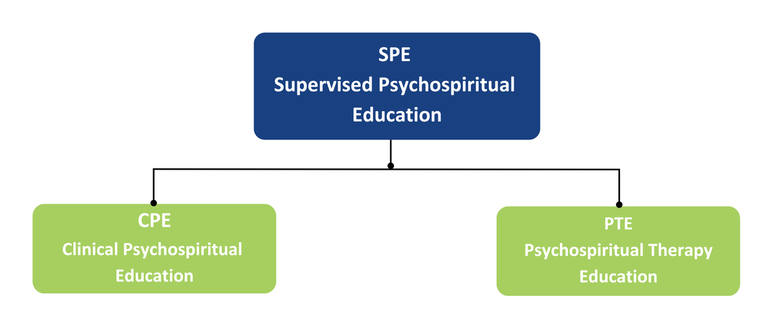
Supervised Psychospiritual Education (SPE)

CASC/ACSS offers internships or placements, called Supervised Psychospiritual Education (SPE), within CASC/ACSS accredited teaching centres across Canada. SPE is education in which students develop the art and skills of spiritual care or psychospiritual therapy, work together with a small group of colleagues while being guided by a qualified Supervisor-Educator. Supervised Psychospiritual Education is unique in that it supports and trains students to integrate their spirituality and theology with psychology and the social sciences. All courses are delivered in person, and students must be on site.

The program is open to theology students and those with equivalent training in their spiritual tradition, spiritual leaders and individuals with counselling or psychology backgrounds who are interested in pursuing a profession in spiritual care or psychospiritual therapy. Programs are offered at teaching centres throughout Canada, including general and psychiatric hospitals, correctional centres and a variety of other locations. Each centre is connected to a Canadian theological college or university. These interdisciplinary contexts maximize student learning by promoting creative dialogue with other professions and collaborations with other workers/agencies serving the community.

Two Streams

CASC/ACSS offers two streams of SPE depending on your interests and professional goals:

Education Levels

In both the CPE and PTE streams, education is offered
at the following levels

Internships

Clinical Psychospiritual Education (CPE)

CPE is ​a fully integrated practical and theoretical experience conducted in units, each totalling a minimum of 400 hours. 200 hours are spent in group settings and seminar instruction and 200 hours are completed in clinical areas. CPE provides training for spiritual care in such places as health institutions, parishes and correctional facilities. CPE units prepare individuals pursuing a profession in Spiritual Care. ​

Psychospiritual Therapy Education (PTE)

PTE ​prepares one for work in mental health agencies, religious settings or private practices. Involves a 400 hour internship offered part time over eight months in which students must complete a minimum of 125 – 150 direct client contact hours providing therapy to clients. Students engage in individual and group supervision and group instruction. PTE units prepare individuals pursuing a profession as Psychospiritual Therapists.

Education Centres

Programs are offered at facilities throughout Canada, including general and psychiatric hospitals, counselling centres, correctional institutions and a variety of other locations. Each centre is connected to a theological institution. A list of education centres for a city, region, or province can be found here.

CASC/ACSS educational programs include clinical internships at 31 of the leading health authorities and organizations across Canada.


Academic Institutions

CASC/ACSS Education programs are given academic credit at over 20 nationally recognized academic institutions across Canada.

FAQS

They are the same.  The title differs depending on where you are.  In Canada “Spiritual Care Practitioner” has mainly replaced the word “Chaplain”. In the US, “Chaplain” is still widely used. Other common terms are Spiritual Health Practitioner and Spiritual Care Provider. 

  • Spiritual Care Practitioners (SCP) are part of the professional care team who are clinically trained to address spiritual needs with a wide variety of people.
  • They work in diverse contexts such as health care, mental health, corrections, educational settings and industry. Like other allied health team members they have a graduate degree and specialized training in their field of expertise.
  • A Certified SCP has two Foundational (Basic) and two Integrative, Contextual (Advanced) units of Clinical Psychospiritual Education (CPE).
  • After CPE training, they have completed 1000 hours of supervised experience and passed a rigorous certification process.
  • A Certified SCP also has a graduate degree (MDiv or equivalent- MA Theology, MA in Spiritual Care,  MA in Religious Studies, MPS – Masters of Pastoral Studies). These are offered by many academic institutions across Canada.
  • Click here to view the sites that offer CPE across  Canada
  • Psychospiritual Therapists (PST) are often part of the professional Care team who are clinically trained to address spiritual needs with a wide variety of people.
  • They can work in private practice or in diverse contexts such as mental health clinics and facilities, or faith based institutions. Like other allied health team members they have a graduate degree and specialized training in their field of expertise.
  • A certified PST has two Foundational (Basic) and two Integrative and Contextual (Advanced) units of Psychospiritual Therapy Education (PTE).
  • Certification requires completing 500 hours of supervised counselling at the Integrative and Contextual (Advanced) level of CASC/ACSS training and a rigorous certification process.
  • Click here to view the sites that offer PTE across Canada
  • A graduate degree (MDiv or equivalent- MA Theology, MA in Spiritual Care,  MA in Religious Studies, MPS Masters of Pastoral Studies) is offered by many academic institutions across Canada.

  • Certification as either a Spiritual Care Practitioner (SCP) or a Psychospiritual Therapist (PST) requires a graduate degree (MDiv or equivalent) and four units of either Clinical Psychospiritual Education (CPE) or Psychospiritual Therapy Education (PTE). 

  • Graduate level degrees usually take two to three years of full-time study.
  • CPE training can be done full time or part time while PTE training is only offered part time over extended periods of time. Each unit requires 400 hours of classroom and clinical time (200 hours of each).
  • A full-time unit is eight hours/day, five days per week, and takes 12 weeks. An extended unit is eight hours/day, two days per week and takes 30 weeks (usually from September to April).   
  • It is possible to take three or four full time units back-to-back in a “Residency” and complete all required CPE units in under a year. A bursary or stipend is available for residencies. Residencies fill up quickly!
  • ​Click here to view residency programs across Canada
  • ​Click here to see a list of current positions advertised across Canada with CASC/ACSS
  • Employment patterns often run in cycles depending on the economy and the environment where positions are offered. Most Spiritual Care positions are found in the health care sector.  If a provincial government is reducing funding to health care, it is likely that positions in Spiritual Care will be reduced. If a government strongly supports funding for health care, spiritual care positions will be increased.
  • Other factors that increase one’s chance of finding a position: if you possess a needed attribute such as a preferred language, a specific religious background, or a desired cultural familiarity. 
  • When there is competition for scarce positions, the person who is most qualified for the job will succeed.  CASC/ACSS works collaboratively with the largest health networks, institutions and organizations offering spiritual care/psychospiritual therapy across the country. Many of these organizations seek employees who are Certified or who have pursued training with CASC/ACSS.  
  • Other factors that increase one’s chance of finding a position with less than the required qualifications are possessing a desired attribute such as a preferred language, a specific religious background, or cultural familiarity. 
  • ​No. Ordination is not required to be a Spiritual Care Practitioner or Psychospiritual Therapist​
  • There is a great overlap between the skill set of clergy persons and Spiritual Care Practitioners (SCPs). It is an advantage that clergy often already have a graduate degree in theology or a related discipline. Clergy often have strong listening skills, an ability to quickly establish caring and safe relationships and are familiar with the need for professional boundaries and confidentiality.
  • A key distinction is that SCPs are trained to provide spiritual care outside of a specific denomination or faith group. Ministering across denominations and faiths and to persons of no faith requires additional training and experience. SCP’s are also trained to work with the medical or mental health care team and are familiar with the specialized systems and processes involved in providing holistic care to persons in crisis and distress. For this reason additional Clinical training– Clinical Psychospiritual Education (CPE) or Psychospiritual Therapy Education (PTE)–is required.
Scroll to Top